As describe in Walden what is Thoreau's assessment of American
Culture (what is wrong with it)? Using specific evidence from the text
discuss and outline his argument. Then respond to it. Do you agree or
disagree with his insights? Discuss.
Sunday, 25 August 2019
NOTES TO LOOK OVER
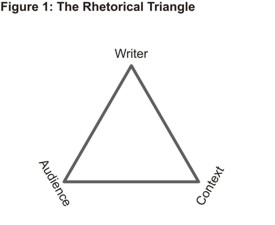
^^^^ The Rhetorical Triangle (Aristotle)
What in the World is Rhetoric???
Well, according to the book, rhetoric
is "a thoughtful, reflective activity leading to effective
communication, including rational exchange of opposing viewpoints." This
to me sounds like the act of opening your mouth and conversing, or
perhaps, debating with someone.
KEY ELEMENTS:
-Context The
context is the occasion that the essay/speech was given. This can be
somewhat like the setting of a story, and by knowing this, you can
properly assess who the intended audience is and whether or not the
context increases the effectivity of the piece.
-Purpose The goal
that the speaker/writer/author wanted to achieve. This coincides with
the context and allows the writer to choose the best possible audience
in which to present the piece.
-Thesis/claim/assertion This could be the
-Subject What the
piece is about, the topic, y'know... so the author should have a very
good grasp on what he/she/it wants to talk about in order to express the
ideas/comments thoroughly and with as much consistency as possible.
Ethos:
Ethos is the character of the writer or the speaker. Good ethos is when
the writer presents his/her/itself as a classy individual while also
coming off as "credible and trustworthy". Allowing the audience to
connect with the author is something that really helps push the point
across and deliver the best results for giving a great speech/rhetoric.
Logos: Logos
is the appeal to logic/reason, by offering the audience clear and
easy-ro-understand ideas that make as much sense as possible, while
remaining rational. Presenting a main idea in a concise manner, showing
another side/counterargument, credible statistics and facts, and/or
expert testimony. (See "Things Fielding told us to include in Persuasive
Essays.")
Pathos: Pathos
is the appeal to emotion. While this isn't something that should be
emphasized as it can come off as propaganda which is not what you want.
Appealing to the emotions means using vivid word choice that can easily
stimulate the readers' thoughts and using the first-person perspective.
The Classical Arrangement of Rhetoric:
1. Introduction (exordium)
-Brings
the reader into the discussion, emerging them into the world of
rhetoric. Introductions can be a couple short sentences, or several
lengthy paragraphs (pages...!). Drawing the reader in is important
(hook) and presenting the main idea (thesis statement) and stating the
order of development. Normally, this is where the author would establish
ethos.
2. Narration (narratio)
-Factual
information is presented and background information give the reader
that much more insight into the subject. This is typically when you
would begin to appeal to logos, yet it is smart to consider appealing to
pathos as you are inclined to evoke an emotional response form the
reader so that they can firmly decide on your opinion with the facts and
statements you present.
3. Confirmation (confirmatio)
-A
large portion of the writing that sets up the proof of your argument
and why the audience should agree. The details in this section should be
strong and thorough, while making the biggest appeal to logos in this
section.
4. Refutation (refutatio)
-This
part of the writing takes a look at the other side of the topic, the
counterargument, if you want to call it that. Used as a "bridge between
the writer's proof and conclusion" but also as appeal to ethos, as the
audience can see that you are passionate enough about your subject that
you chose to research both sides to get as informed as possible.
5.Conclusion (peroratio)
-Closing
the essay, appealing to pathos one final time as well as connecting
with ethos set up in the beginning of the piece. Instead of repeating
what has already been said (guilty of this on several occasions... :l ),
the writer's ideas should all get compacted into one and "answers the
question, so what?" The last words are usually the ones that the
audience is going to remember, so make them count. Throw it all out on
the table and sum up the essay with as much intelligence as possible!
Patterns of Development: Authors
can change their arrangement by writing in order of purpose. Each
method of writing purposefully has its own way of organizing thoughts
and piecing together all the little eccentricities neatly and
professionally.
Types of Essays We'll Be Writing: Narration: Tells a story and
recounts tales of slaying dragons and mystical creatures. Not really,
but narration is typically a recollection of previous events, usually
chronologically, or as a means to enter into the main idea of an essay.
Description: Much like narration and
just as detailed (if not, more so), but the details focus more on the
sensory responses from the readers. These include, the ways things
taste, the sounds around the writer, textures and feelings, sights,
colours, setting up an atmosphere for the piece. The descriptive
language is a way to help make thoughts more approachable to the readers
and helps in being more persuasive. ProcessAnalysis: An
explanation. A how-to. The steps on how to achieve something or engage
in a process. These can best be found in (according to the book)
self-help books. Because these are going to help the way someone lives
or acts, you must be as clear as possible in the instruction with
smooth, flowing transitions as to not miss a step or confuse anyone. Exemplification: Hopefully, this is
readable... Facts, examples, testimonies are all ways to make an idea
complete. With complete ideas, come more acceptable readers and easier
persuasion. Comparison and Contrast: Highlighting
similarities and differences in an organized fashion allows clear
presentation of points that can be easy to digest for the audience. With
careful analytics, the author can find interesting tidbits of
information that could open up ideas to readers that otherwise couldn't
be achieved, as well as highlighting both sides of an argument or
multiple angles of a topic. Classification and Division: Sorting
information into how topics go together and why. Connections can be
made between things that are seemingly unrelated and thus, like
Comparison and Contrast, can reveal difference aspects to the reader
that otherwise were unknown. Definition: Defining something can
allow more points to come through and allow "meaningful conversation".
Example: (See what I'm doing here?) Let's talk about how awesome
alligators are. But before we do this, we must DEFINE what counts as "awesome". Perhaps a dictionary definition. Cause and Effect: Causes and
Effects. Self explanitory... "The effects that result from a cause is a
powerful foundation for argument." Seems legit.
Those of you who are having a hard time with the AP prompts - think about the following things.
Question 1 - synthesis essay is an argument essay. You need to take a position and back up that position with at least three articles that are given to you. Beyond this you should - connect to other other sources and the world. Make sure you analysis the sources in relation to your thesis. Don't just summarizes them.
Question 2 - Analytical Essay. You are analyzing a passage here. Think precis. Make sure you find the authors thesis and purpose. Then show how the author creates this in the passage. Review precis if needed.
Question 3 - Argument essay. Make sure you create an argument here and back it up with specific examples.
You don't necessarily need a hook, but you do need a thesis.
We are going to debate the wording of the 2nd Amendment and then look at the AP - steps to success book.
First, I need everyone to turn in all essays from Modes of Composition project, and then all essays from AP Practice Questions. Finally - who is not showing up next week?
Okay - so most of you demonstrated that you still remember how to write a precise. The key is can you do it in 10 minutes.
So, we are going to go over the test and its structure this week, and practice the multiple choice questions. Note, when you get back from Spring Break you will be writing many practice essays, so be prepared.
First - before we get into Cracking the AP Language and Composition Exam. let's talk about student walkouts and gun control.
Today we are going to read "Women's Brains" by Jay Gould in The Language of Composition on page 518. After we finish reading you will write a Precise on it.
If we have time left over in class you can work on your rewrites.
Today we are going to read "Working for A Living: the Codes for Work and Money" by Clotaire Rapaille in One Hundred Great Essays on page 482. After we finish reading you will write a Precise on it.
If we have time left over in class you can work on your rewrites.
A rhetorical précis analyzes both the content (the what) and the delivery (the how) of a unit of
spoken or written discourse. It is a highly structured four-sentence paragraph blending summary
and analysis. Each of the four sentences requires specific information; students are expected to
use brief quotations (to convey a sense of the author’s style and tone) and to include a terminal
bibliographic reference. Practicing this sort of writing fosters precision in both reading and
writing, forcing a writer to employ a variety of sentence structures and to develop a discerning
eye for connotative shades of meaning.
Take a look at the overall format 1)
Name of author, (optional: a phrase describing the author), genre and
title of the work, date in parentheses (additional publishing
information in parentheses); a rhetorically accurate verb (such as
"assert," "argue," "suggest," "imply," "claim," etc.); and a THAT clause
containing the major assertion (thesis) of the work. 2) An explanation of how the author develops and/or supports the thesis, usually in chronological order. 3) A statement of the author's apparent purpose followed by an "in order to" phrase. 4) A description of the intended audience and/or the relationship the author established with the audience.
Now take a closer look:
1. THE FIRST SENTENCE identifies the essay's author and title, provides the article's date in
parenthesis, uses some form of the verb says (claims, asserts, suggests, argues—) followed by
that, and the essay's thesis (paraphrased or quoted).
EXAMPLE: In "The Ugly Truth about Beauty" (1998), Dave Barry argues that
"...women generally do not think of their looks in the same way that men do" (4).
EXAMPLE: In "The Ugly Truth about Beauty" (1998), Dave Barry satirizes the
unnecessary ways that women obsess about their physical appearance.
2. THE SECOND SENTENCE conveys the author's support for the thesis (how the author
develops the essay); the trick is to convey a good sense of the breadth of the author’s
support/examples, usually in chronological order.
EXAMPLE: Barry illuminates this discrepancy by juxtaposing men's perceptions of
their looks ("average-looking") with women's ("not good enough"), by contrasting
female role models (Barbie, Cindy Crawford) with male role models (He-Man, Buzz-
V. Stevenson and M. Frerichs, AP Language
PHHS, San Diego, reprint date: 5/24/2010
Off), and by comparing men's interests (the Super Bowl, lawn care) with women's
(manicures).
3. THE THIRD SENTENCE analyzes the author's purpose using an in order to statement:
EXAMPLE: He exaggerates and stereotypes these differences in order to prevent
women from so eagerly accepting society's expectation of them; to this end, Barry
claims that men who want women to "look like Cindy Crawford" are "idiots"(10),
implying that women who adhere to the Crawford standard are fools as well. 4. THE FOURTH SENTENCE describes the essay's target audience and characterizes the
author's relationship with that audience—or the essay's tone: EXAMPLE: Barry ostensibly addresses men in this essay because he opens and
closes the essay directly addressing men (as in "If you're a man...”) and offering to
give them advice in a mockingly conspiratorial fashion; however, by using humor to
poke fun at both men and women’s perceptions of themselves, Barry makes his essay
palatable to women as well, hoping to convince them to stop obsessively "thinking
they need to look like Barbie" (8).
Put it all together and it looks darn smart:
In "The Ugly Truth about Beauty" (1998), Dave Barry argues that ". . . women generally do not
think of their looks in the same way that men do"(4). Barry illuminates this discrepancyby
juxtaposing men's perceptions of their looks ("average-looking") with women's ("not good enough"),
by contrasting female role models (Barbie, Cindy Crawford) with male role models (He-Man, Buzz-
Off), and by comparing men's interests (the Super Bowl, lawn care) with women's (manicures). He
exaggerates and stereotypes these differences in order to prevent women from so eagerly accepting
society's expectation of them; in fact, Barry claims that men who want women to "look like Cindy
Crawford" are "idiots" (10). Barry ostensibly addresses men in this essay because he opens and
closes the essay directly addressing men (as in "If you're a man...”) and offering to give them advice
in a mockingly conspiratorial fashion; however, by using humor to poke fun at both men and
women’s perceptions of themselves, Barry makes his essay palatable to both genders and hopes to
convince women to stop obsessively "thinking they need to look like Barbie" (8).
"Women and Honor: Some Notes on Lying" by Adrienne Rich
"Working for A Living: the Codes for Work and Money" by Clotaire Rapaille
"Women's Brains" by Jay Gould
"Hip Hop Planet" by James McBride
Today is the last day - in class - to work on your essays. Remember your "Cause and Effect" essay is due on Monday, and then you will have a week to work on your rewrites. Most of that rewriting will be homework. Final drafts on due on March 21st.
We need to go back to looking closely at Essays and analyzing them.
Here is the reading we need to try and finish before Spring Break:
·“The Conversation” by Wendy Lesser
·“The Keyboard” by William Zinsser
·“The Golden Spike” by John Steele Gordon
·“Selected Web Sites” by Dave Barry
·“Women and Children First: Gender and Settling
of the Electronic Frontier” by Laura Miller
·“Welcome to Cyberbia” by M. Kadi
·“Looking for Community on the Internet” by Evan
I Scharz
CAUSE AND EFFECT Points to Remember 1. Remember that in human events you can almost never prove direct, simple, cause and effect relationships, Qualify your claims. 2. Be careful not to oversimplify your cause and effect statements, be cautious about saying that a cause always produces a certain effect of that a remedy never succeeds. 3. Distinguish between the immediate, obvious cause of something and more long range, less apparent causes for that effect. 4. Avoid confusing coincidence or simple sequence with cause and effect; because B follows A doesn’t mean that A caused B. 5. Build your cause-and-effect argument as a trial lawyer would. Present as much evidence as you can and argue for your hypothesis.
Remember that in human events you can almost
never prove direct, simple, cause and effect
relationships, Qualify your claims.
Be careful not to oversimplify your cause and
effect statements, be cautious about saying that a
cause always produces a certain effect of that a
remedy never succeeds.
Distinguish between the immediate, obvious
cause of something and more long range, less
apparent causes for that effect.
Avoid confusing coincidence or simple sequence
with cause and effect; because B follows A
doesn’t mean that A caused B.
Build your cause-and-effect argument as a trial
lawyer would. Present as much evidence as you
can and argue for your hypothesis.
Turn in Definition Essays. Begin Persuasion/Argumentation Essays.
ARGUMENT AND PERSUASION Points to Remember
1. Remember that in order to argue well, you must understand your audience and know your purpose.
2. Understand the three principal kinds of appeal emotional appeal, the
appeal to intelligence and reason; and ethical appeal, the appeal from
the character and competence of the author. The most effective arguments
combine all three.
3. Construct an argument as a lawyer would construct a case to present
to a jury; state your assertions and back them up with evidence and
reason, appealing to your readers’ intellect and feelings.
4. Always assume your audience is intelligent, although some members of it may be uninformed on a particular issue.
5. Avoid three common pitfalls: (a) don’t overstate your claims, (b) be
careful not to oversimplify complex issues; and (c) support your
arguments with concrete evidence, not generalizations.
Today - you need to turn in your Division and Classification Essays and begin to work on your DEFINITION Essay.
Review in the river reader the definition essay.
DEFINITION
Points to Remember
Remember that you are obligated to define
key terms that you use in your writing—
such as Marxism, alternative medicine,
nontraditional student.
Understand your purpose in defining: to
explain, to entertain, to persuade, to set
boundaries, or to establish a standard.
Understand how writers construct an
argument from a definition. For example,
by defining the good life or good
government, they argue for that kind of
life or government.
Know the several ways of defining: giving
examples, analyzing qualities, attributing
characteristics, defining negatively, using
analogies, and showing function.
Learn to use definition in combination
with other strategies, as a basis on which
to build an argument, or as supporting evidence. Remember Al's Definition Essay:
The one thing that we can control
in our lives is our personal reactions to the events occurring around us. Do we
stand up and speak up about abuse, or sit back as our best friend turns down an
offer of a lifetime? We are responsible for our actions. We must take control
and stand up for what we believe to be morally right. All throughout history
there have been incidents of leaders taking initiative and standing up for what
they believe in. Conversely, there have also been moments of weakness; cowards
whom don’t speak up, passer-bys who don’t stop to report a crime, or help a victim.
These moments do not define the person at fault, but rather emphasize the
importance of the brave ones who do stay with the victim, who do call 911, who
take a stand.
One
Significant Transcendentalist Philosopher, Henry David Thoreau, showed responsibility when he denied support
of a war that was, in his mind, immoral. Thoreau was asked to pay a poll tax
that supported the Mexican American War, but because the war was a ploy to gain
territory in the South, allowing slavery to thrive, Thoreau
refused. This is a classic example of responsibility. It was
Thoreau’s moral obligation to refuse to pay the poll tax because he did not
believe in what it supported. If he had paid the poll tax because the
government told him to then this would be an example of cowardice.
Another instance of responsibility
can be seen in Eugene V. Debs’s speech against World War I. Although he knew
that he would be arrested due to the Sedition Act. He believed that it was his
moral duty to speak up about the injustice of the World War. He advocated for
the common people to have the right to declare war or peace. Although Debs went
to prison for his speech he was responsible in doing so because he took action
against his suppressor.In fact he was
able to run for presidency while he was in prison.
While
there are many situations where people show their responsibility and maturity,
there are also plenty of cowardice moments in history. Everyone has a flaw,
even the people in the Bible. Pontius Pilate’s weakness in the face of a
rioting mob calling for Jesus' death, even though he knew of his innocence is
the ultimate show of cowardice. Although Pilate had the power to set Jesus
free, his fear of insurrection prevented him from making the right moral choice. Cowardice
appears to be one of the main themes of many pieces of literature, and society.
So maybe the human race as a whole are guilty of it? And if we are all guilty
of cowardice, then we must all be guilty of responsibility at times as well
because you cannot have one without the other.
With such
chaos going on in our lives, we should control the one thing we have authority
over: our actions. The way we respond and learn can define your life. You learn
from your and others’ mistakes, however, so cowardice is essential in
developing responsibility and bravery in society.
If you are done with your Classification and Division essay, please begin your DEFINITION essay. Look over it in your river reader and think about/adhere to this list: Definition (draft) due 2/26 DEFINITION Points to Remember
Remember
that you are obligated to define key terms that you use in your
writing— such as Marxism, alternative medicine, nontraditional student.
Understand your purpose in defining: to explain, to entertain, to persuade, to set boundaries, or to establish a standard.
Understand
how writers construct an argument from a definition. For example, by
defining the good life or good government, they argue for that kind of
life or government.
Know
the several ways of defining: giving examples, analyzing qualities,
attributing characteristics, defining negatively, using analogies, and
showing function.
Learn
to use definition in combination with other strategies, as a basis on
which to build an argument, or as supporting evidence.
For those of you starting your Division
and Classification essay, remember you are creating categories.
Example, if your theme was running you might classify the types of
workouts an athlete might used in order to be successful. If your theme
was Power you might discuss different types of power a country might
have or need to be a world leader. Remember Al Weber's essay on the
types of homework an AP student might have.